
In recent years, frequent rapid temperature fluctuation events worldwide have posed serious threats to public health, ecological security, and economic growth. In response to this cutting-edge challenge, Academician Congbin Fu's team at the School of Atmospheric Sciences, Nanjing University, has conducted over a decade of systematic research, uncovering the spatiotemporal characteristics, driving mechanisms, and health impacts of rapid weather changes characterized by sudden shifts between cold and warm spells under global warming.
Congbin Fu and his colleagues found that traditional extreme climate indices, mostly based on single-day temperature thresholds, are inadequate for effectively capturing sharp fluctuations in consecutive daily temperatures. By integrating multi-source observational data, reanalysis data, and multi-model simulation results from the Coupled Model Intercomparison Project Phase 6 (CMIP6), the research team defined extreme interdiurnal temperature change events as those where the temperature difference between two consecutive days exceeds the historical 90th percentile threshold. Analysis shows that under global warming, such events have significantly intensified in low- to mid-latitude regions (Figure 1), with a notable shortening of their recurrence intervals. Optimal fingerprint attribution analysis confirmed that greenhouse gas forcing is the dominant factor driving these changes (Figure 2). Further projections based on CMIP6 models indicate that under medium- to high-emission scenarios, extreme interdiurnal temperature changes in low- to mid-latitude regions will continue to intensify by 2100. Under high-emission scenarios, the frequency, fluctuation amplitude, and total intensity of these events are projected to increase by approximately 17%, 3%, and 20%, respectively, affecting regions inhabited by over 80% of the global population.
The study also mechanistically explains that global warming exacerbates soil drought, intensifies sea level pressure and soil moisture variability, and other land-atmosphere processes, which reduce surface heat capacity and amplify interdiurnal fluctuations in cloud cover and radiation, ultimately leading to rapid temperature fluctuations (Figure 3). Additionally, based on mortality data from Jiangsu Province, China, and the United States, the study reveals that the health impact of extreme interdiurnal temperature variability significantly exceeds that of diurnal temperature range. Its association with all-cause mortality follows a nearly exponential growth pattern, particularly exacerbating the risks of cardiovascular and respiratory diseases.
Academician Fu Congbin emphasized: This study systematically distinguishes extreme interdiurnal temperature variability from traditional extreme climate indices, establishing its scientific standing as an independent indicator. Global warming is continuously intensifying extreme day-to-day temperature fluctuations in mid- and low-latitude regions, posing severe challenges to public health and ecosystem resilience and adaptability. There is an urgent need to enhance attention and research on such extreme events. We also recommend that relevant international scientific organizations classify it as a new type of extreme weather event.
The findings were published online in Nature Climate Change under the title Global warming intensifies extreme day-to-day temperature changes in mid–low latitudes. Academician Congbin Fu from the School of Atmospheric Sciences at Nanjing University served as the corresponding author, with Assistant Professor Qi Liu as the first author. Collaborators included Researcher Zhongfeng Xu from the Institute of Atmospheric Physics, Chinese Academy of Sciences, and Professor Aijun Ding from Nanjing University. The research was supported by the National Key Research and Development Program of China (2023YFF0805503, 2022YFF0802503), the Climate Change Jiangsu Collaborative Innovation Center, and the Frontiers Science Center for Critical Earth Material Cycling at Nanjing University. The authors also extended sincere gratitude to scholars who provided valuable suggestions during the manuscript revision process.
Paper link:
Liu, Q., Fu, C., Xu, Z., Ding, A. Global warming intensifies extreme day-to-day temperature changes in mid–low latitudes. Nature Climate Change (2025). https://doi.org/10.1038/s41558-025-02486-9
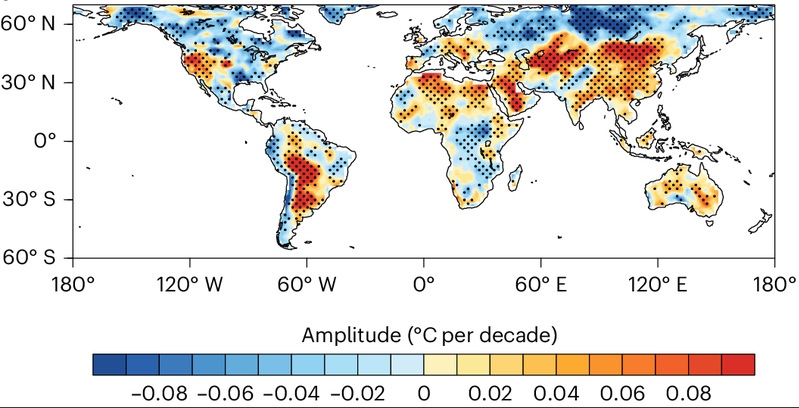
Figure 1. Changes in the magnitude of extreme interdiurnal temperature variability events of daily maximum temperature from 1961 to 2020 based on Berkeley Earth observation data.
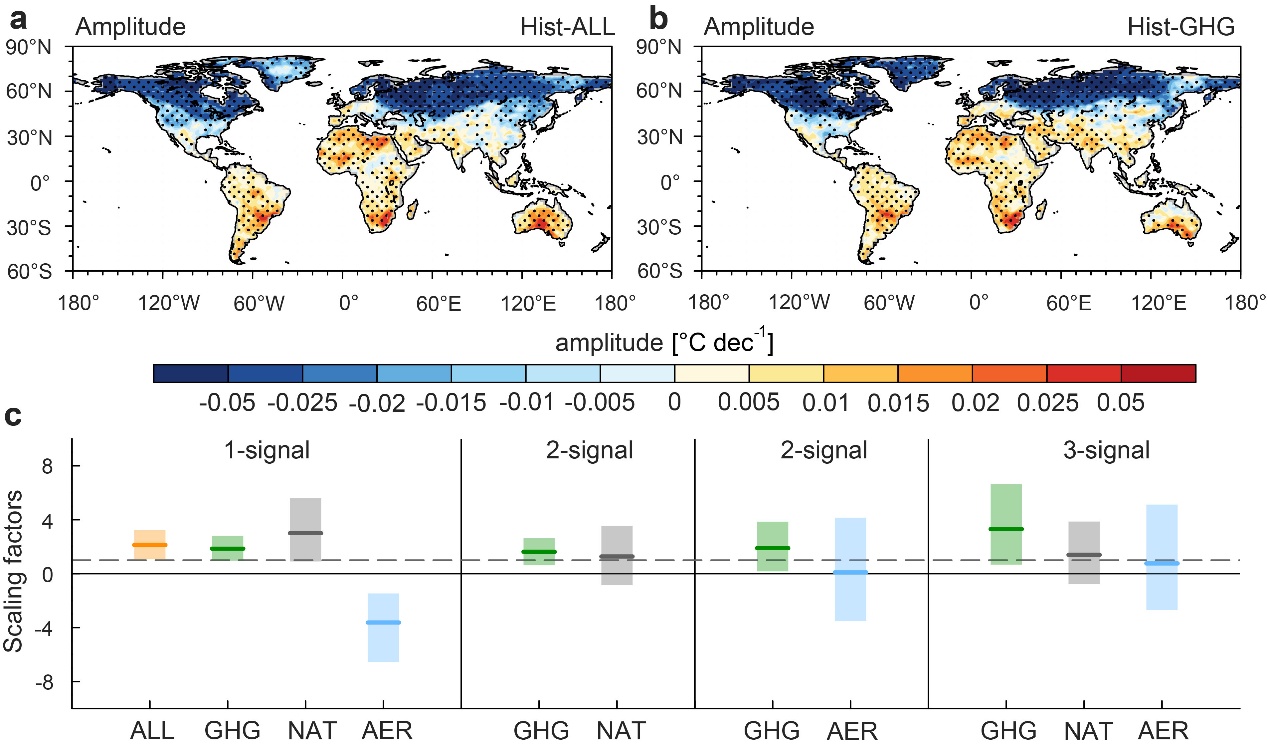
Figure 2. Simulation, detection, and attribution of extreme interdiurnal temperature variability events of daily maximum temperature. Panel (a) shows the long-term trend simulated under all forcings (ALL). Panel (b) shows the simulated trend under greenhouse gas (GHG) forcing alone. Panel (c) presents the results of the optimal fingerprint analysis, displaying the signal scaling factors under different forcing combinations.
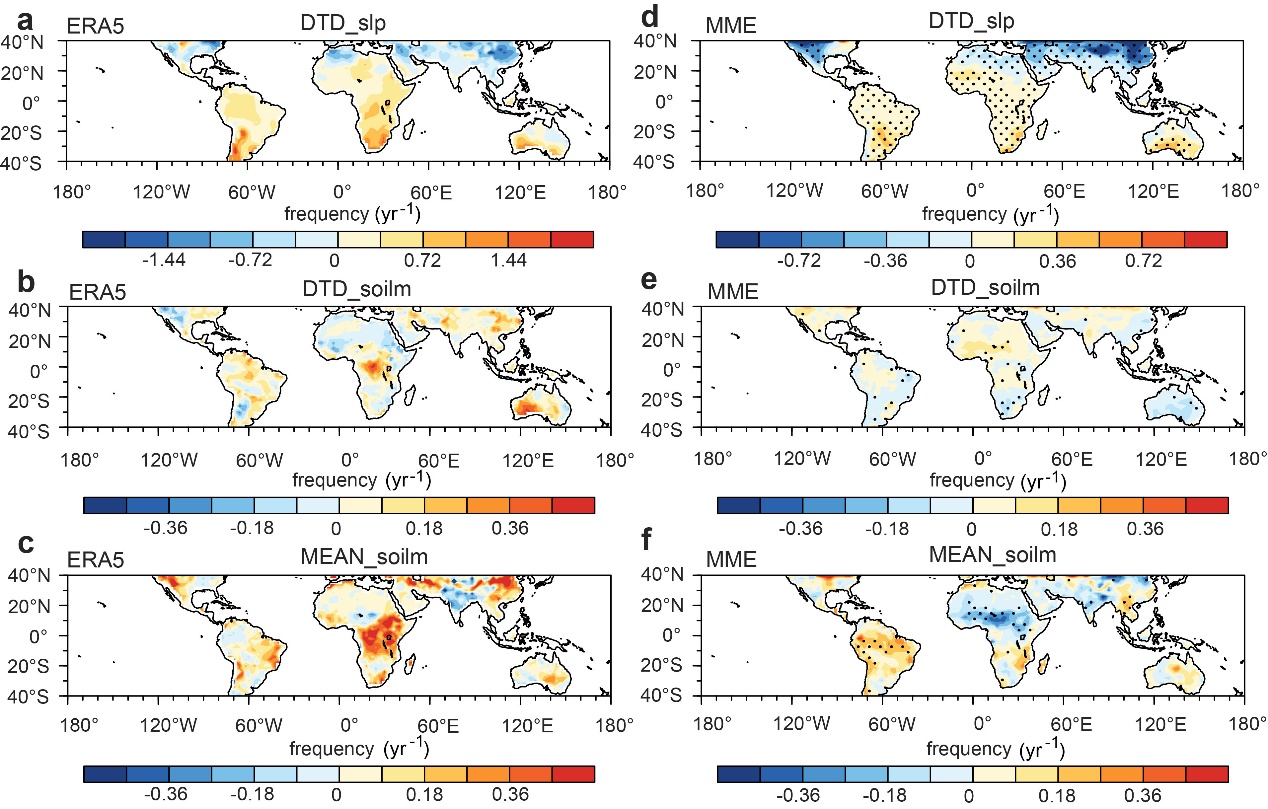
Figure 3. Contributions of day-to-day variability (DTD) and mean state (MEAN) of different variables to the long-term changes in extreme interdiurnal temperature variability events within the 40°S–40°N region. The left column shows results from ERA5 reanalysis data, and the right column shows the multi-model mean results from CMIP6. Analyzed variables include sea level pressure (slp), soil moisture (soilm), among others.