
Researchers from the School of Atmospheric Sciences, Nanjing University, together with collaborators from the School of History, the Institute of Geographic Sciences and Natural Resources Research of the Chinese Academy of Sciences, and other institutions, have published a study on ancient extreme weather events and societal responses. By integrating oracle bone scripts, archaeological evidence, paleoclimate proxy data, modern meteorological analyses, and both AI-based and physics-based numerical models, the team identified a period of intensified typhoon activity around 3,000 years ago and revealed its links to extreme rainfall, flood disasters, and related social changes in inland China.
The middle to late Holocene was a key period of pronounced fluctuations in the global climate system, during which multiple centers of civilization experienced environmental change and social transformation. Several regions of Bronze Age China likewise experienced population fluctuations and shifts in settlement patterns, yet the specific links between these changes and extreme weather events have yet to be fully understood. To address this question, the research team adopted an integrated framework combining ancient evidence, modern atmospheric mechanisms, and numerical experiments to reconstruct the chain of connections between ancient extreme weather processes and social change.
In the Central Plains, the research team systematically quantified weather-related divination records in Late Shang oracle bone inscriptions, extracted rainfall-related information, and used these data to reconstruct changes in rainfall and heavy-rainfall risk across different phases of the Late Shang period. At the same time, the team analyzed the overall trend of population change based on radiocarbon dating data. In the Chengdu Plain, the researchers used archaeological evidence, including the number and spatial distribution of sites as well as flood deposits, to examine the relationship between changes in regional environmental risk and settlement evolution (Figure 1).
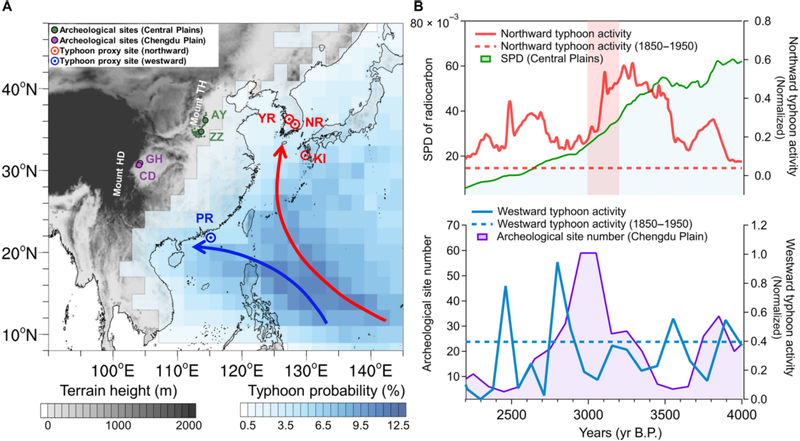
Fig. 1. Temporal changes in typhoon activity, population size (Central Plains), and archeological site number (Chengdu Plain) during the mid-late Holocene. (A) Distribution of typhoon probability in modern times (1950 to 2021) and the locations of archeological sites and paleo-typhoon proxies used in this study. (B) Fluctuations in normalized northward typhoon activities and variations in population size in the Central Plains [represented by the reconstructed summed probability distributions (SPD); top]; fluctuations in westward typhoon activities and the temporal distribution of archeological sites in the Chengdu Plain (bottom). The red (blue) dashed lines give the northward (westward) average typhoon activities during 1850 to 1950. The time range of oracle bone scripts is indicated by the red translucent strip on the top panel.
By comparing these findings with geological records of paleo-typhoon activity, the team found that periods of intensified northward- and westward-moving typhoon activity closely coincide with population and social changes in both the Central Plains and the Chengdu Plain. These intervals of intensified typhoon activity also align with several additional lines of evidence, including rainfall and heavy-rainfall variations inferred from oracle bone inscriptions, flood deposits identified at sites in the Chengdu Plain, and evidence that settlements shifted toward relatively higher ground. Taken together, these findings suggest that intensified typhoon activity may have played an important role in population and social change by increasing the risk of extreme rainfall and flooding.
To further test this interpretation, the team conducted a statistical analysis of meteorological data from the past 70 years and found that a substantial proportion of extreme rainfall events in the Central Plains and the Chengdu Plain were associated with typhoon activity. Building on this, the researchers combined physics-based models, including WRF and CESM2, with the Pangu-Weather model (AI model) to carry out a large set of idealized experiments that quantitatively assessed the effects of stronger typhoons on extreme rainfall in inland China. The results show that stronger typhoons can significantly increase the risk of extreme rainfall in parts of inland China, especially in the Central Plains and the Chengdu Plain (Fig. 2), thereby providing mechanistic support for the interpretation of the ancient cases.
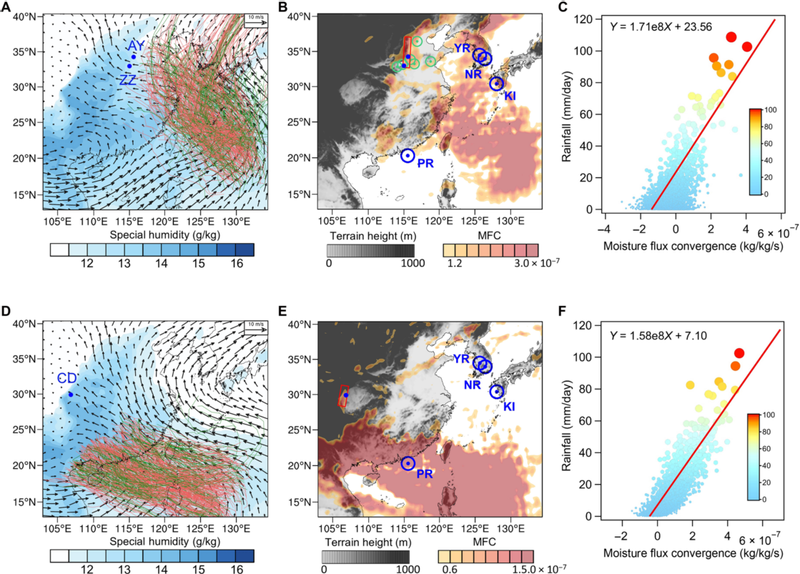
Fig. 2. Simulated changes in extreme rainfall due to an increase in typhoon intensity. (A) Average specific humidity distribution and wind field at 850 hPa when northward typhoons occur; total of 261 cases. Tracks of weak and strong typhoons are shown in green and red lines. (B) Changes of upper quartile of maximum moisture flux convergence (MFC) between simulations with strong and weak typhoons. Blue circled dots give the locations where mid-late Holocene typhoon proxies used in this study are retrieved. Green circled dots show the distribution of flood deposits that document flood events around 3000 yr B.P. when northward typhoon activities increased. (C) Scatter plots of MFC and daily rainfall in the Central Plains [red box in (B)] in summer time during 1950 to 2021. The red line shows the reduced major axis regression, which was set using the fitting function labeled on the top-left corner. (D to F) Same as (A) to (C) but for westward typhoons (total of 319 cases), MFC, and daily rainfall in the Chengdu Plain.
Integrating atmospheric science with evidence and methods from history, archaeology, geography, and geology, this study extends research on extreme weather beyond the modern period to reconstruct disaster processes and their social impacts during the middle to late Holocene. This interdisciplinary approach provides a new perspective on the relationship between climate influences and social changes around 3,000 years ago, while also underscoring the need to pay closer attention to the potential impacts of typhoon-related extreme rainfall and flood risk in inland regions today in a warming climate.
The study, titled "Archeological data with AI- and physics-based modeling explain typhoon-induced disasters in inland China around 3000 yr B.P.", was published in Science Advances. Its co-first authors are Dr. Ke Ding, tenure-track assistant professor at the School of Atmospheric Sciences, Nanjing University, and Dr. Siyang Li, tenure-track associate professor at the School of History, Nanjing University. The corresponding author is Prof. Quansheng Ge of the Institute of Geographic Sciences and Natural Resources Research, Chinese Academy of Sciences. Co-authors also include Academicians Congbin Fu and Zhemin Tan, Prof. Aijun Ding of the School of Atmospheric Sciences, and researchers from the Institute of Geology and Geophysics, Chinese Academy of Sciences, the University of Hong Kong, and other institutions. The research was jointly supported by the General Program of the National Natural Science Foundation of China (42475053), the Collaborative Innovation Center on Climate Change, and the Frontiers Science Center for Critical Earth Material Cycling, among other sources.
paper link: https://www.science.org/doi/10.1126/sciadv.aeb1598